The hardest part of improving at badminton is often not the sport itself. It's finding a free court, a partner whose schedule matches yours, and the time to get there. Plenty of beginners stop progressing simply because they only touch a racket once or twice a week.
The good news is that you can practise badminton alone and still make real progress. Grip, racket control, footwork and swing technique can all be trained in a living room, a terrace or a car park. This guide gives you seven solo drills, a simple weekly plan and the safety basics. If you're brand new to the sport, start with the Badminton Guide for Beginners on Kheloexch, a complete badminton guide for new players covering the court, rules and kit.
What it builds: shuttle control, timing and a feel for the racket face.
How to do it: Hold the racket in the forehand grip and bounce the shuttle upwards off the strings, keeping it at roughly head height.
What it builds: fast, automatic changes between the forehand and backhand grip.
How to do it: Hold the racket in front of you in the ready position. Switch from forehand to backhand grip and back, 20 times slowly. Then repeat with your eyes closed, checking by feel. Finish with 20 quick switches, imagining a shuttle coming to alternate sides.
What it builds: reaction speed, drive technique and wrist control.
How to do it: Mark a line on the wall at net height, 1.524 m from the floor. Stand about 2 to 3 metres back and hit the shuttle against the wall above the line, keeping a rally going. Start with forehand drives, then backhand, then alternate.
Aim for rallies of 20, then 50, then 100 hits. Control matters more than power: a soft, steady rally teaches more than a fast one that keeps breaking down.
What it builds: clean technique for overhead and backhand strokes.
How to do it: Without a shuttle, practise full swings for each basic shot: clear, drop, smash and backhand lift. Turn side-on, point your free hand up, rotate through the swing and follow through. Do 10 slow, perfect swings of each, then 10 at normal speed.
A mirror or a phone video helps you spot problems such as a bent elbow, a front-on body position or a short follow-through.
What it builds: court movement and recovery to base.
How to do it: Mark a central base and six points around it: two at the front, two at the sides and two at the back. From base, make a small split step, move to a point, play a shadow shot, and return to base. Visit all six points in order for one round.
Do three rounds with a 60-second rest between them. Focus on smooth steps first; speed comes later.
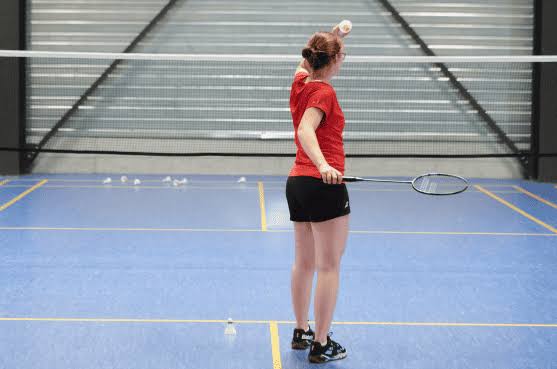
What it builds: footwork, low reaching and leg strength.
How to do it: Place six shuttles at your base and an empty marker in a corner. Move to the corner with proper footwork, place one shuttle on the marker in a lunge position, return to base, and repeat until all six are moved. Then carry them back one at a time. Do 3 to 5 sets for each corner.
What it builds: a consistent, legal serve.
How to do it: Tie a string or rope across two chairs at roughly net height. Place a towel or bucket about 2 metres beyond it as a target. Serve 20 low serves over the string onto the towel, then, if you have enough space, 10 higher serves aiming deeper. Count your hits each session and try to improve the number every week.
Remember the service rule: the whole shuttle must be below 1.15 m from the floor when you strike it.
| Day | Focus | Drills | Time |
|---|---|---|---|
| Monday | Control | Racket bounces, grip switches, wall rallies | 20 min |
| Wednesday | Movement | Shadow footwork, shuttle transfer, skipping | 20 min |
| Friday | Technique | Shadow swings, target serves, wall rallies | 20 min |
| Weekend | Play | A real game or club session, if possible | As available |
Start every session with five minutes of light jogging, arm circles and leg swings, and finish with a few minutes of stretching.
You don't need a partner or a booked court to get better at badminton. Racket bounces and grip switches build control, wall rallies sharpen your reactions, and shadow swings and footwork drills groove the movements that matter on court. Twenty minutes, three times a week, will make your next real game feel noticeably easier. Combine these drills with regular play and a solid grasp of the rules from the Badminton Guide for Beginners on Kheloexch, and you'll keep improving even on weeks when you can't get to a court.
Can you really improve at badminton by practising alone?
Yes. Solo drills build racket control, grip changes, footwork and swing technique, which are the foundations of every shot. You'll still need games with other players to develop tactics and timing, but home practice makes those games far more productive.
How do I practise badminton against a wall?
Mark a line at net height, 1.524 m, and stand 2 to 3 metres back. Hit the shuttle against the wall above the line with forehand and backhand drives, keeping a steady rally. Focus on control first, then build up to longer rallies.
How much space do I need for badminton practice at home?
About 3 by 3 metres is enough for racket bounces, grip drills and wall rallies. Footwork and shuttle-transfer drills need a little more room, and full overhead swings need a high ceiling or an outdoor space such as a terrace.
How often should I do solo badminton drills?
Two or three sessions of around 20 minutes a week work well for most beginners. Short, regular sessions build skills faster than occasional long ones and give your body time to recover between workouts.
What is shadow badminton?
Shadow badminton means practising footwork and strokes without a shuttle. You move around the court or a marked space, playing imaginary shots and recovering to base. It trains movement patterns and technique without needing a partner or court.

This post has been authored and published by one of our premium contributors, who are experts in their fields. They bring high-quality, well-researched content that adds significant value to our platform.










Paris in France is your trusted source for Paris travel guides, cultural insights, attractions, lifestyle articles, and local experiences. Explore the beauty and charm of Paris with us.